Quick answer
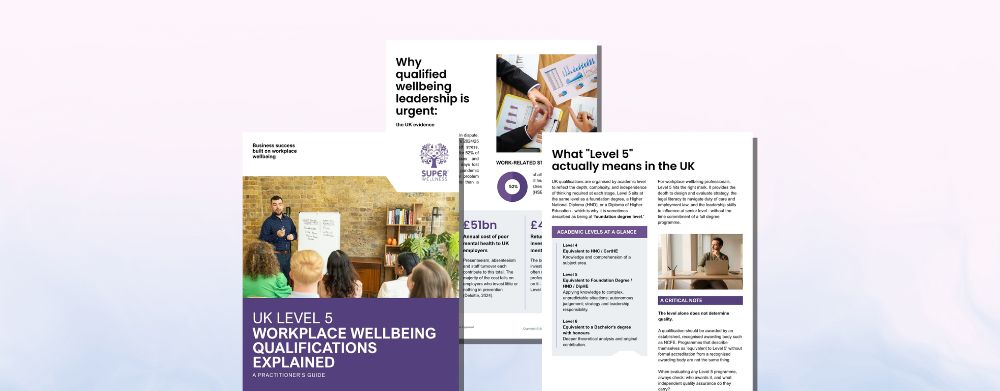
A Wellbeing Level 5 Diploma qualification sits at the same academic level as a foundation degree. It gives HR professionals, wellbeing leads, and occupational health practitioners the strategic and practical skills to design, lead, and evaluate workplace wellbeing programmes. Not every Level 5 programme carries the same credibility. Look for formal accreditation from a recognised awarding body such as NCFE, professional body recognition (such as SOM Recognised Education status), and workplace-based assessment rather than purely theoretical exams.
As Course Director for the SuperWellness Accredited Level 5 Diploma in Leading Strategic Workplace Wellbeing, and as an Organisational Psychologist who has worked with organisations across sectors, I am regularly asked what makes a Level 5 qualification worth investing in, who it is designed for, and how to tell credible programmes from the rest. This guide answers all of those questions, drawing on current UK evidence and my own practice.
Why qualified wellbeing leadership is urgent: the UK evidence
The financial picture is equally stark. Deloitte’s 2024 analysis of the cost of poor mental health to UK employers put the total at up to £51 billion per year – a combination of presenteeism (working while unwell), absenteeism, and staff turnover (Deloitte, 2024). The same research found that, on average, for every £1 an employer invests in employee mental health support, they receive £4.70 in return. The investment case is compelling; what is often missing is the professional capability to make it happen.
The Stevenson/Farmer review, Thriving at Work (2017), identified that approximately 300,000 people with long-term mental health problems fall out of employment each year in the UK, and that around 15% of workers already have symptoms of an existing mental health condition. Years on from that landmark review, the CIPD’s Health and Wellbeing at Work survey found that many organisations continue to experience work-related stress, and that fewer than two thirds feel they have an effective wellbeing strategy in place (CIPD, 2025).
These are not numbers that shift through awareness campaigns alone. They shift through qualified, strategically capable wellbeing professionals who understand the evidence, the law, and the organisational systems they are working within. That is the case for a Level 5 qualification.
What “Level 5” actually means in the UK
- Level 4 (equivalent to HNC / CertHE) Knowledge and comprehension of a subject area.
- Level 5 (equivalent to Foundation Degree / HND / DipHE) Applying knowledge to complex, unpredictable situations; autonomous judgement; strategy and leadership responsibility.
- Level 6 (equivalent to a Bachelor’s degree with honours) Deeper theoretical analysis and original contribution.
A critical note: the level alone does not determine quality. A qualification should be awarded by an established, recognised awarding body such as NCFE. Programmes that describe themselves as ‘equivalent to Level 5’ without formal accreditation from a recognised awarding body are not the same thing. When evaluating any Level 5 programme, always check: who awards it, and what independent quality assurance do they carry?
What a Level 5 workplace wellbeing diploma covers
Strategic wellbeing leadership
Legal and ethical frameworks
Psychosocial risk assessment
Culture change and stakeholder influence
Measurement and reporting
Intervention design and evaluation
Who should study a Level 5 wellbeing qualification
- HR managers and business partners taking on wellbeing responsibility and needing a credible, structured framework
- Wellbeing leads who are self-taught or have attended short courses and want recognised, formally assessed accreditation
- Occupational health practitioners looking to expand into strategic wellbeing leadership
- Health and safety professionals looking to integrate wellbeing into their practice
- L&D professionals embedding wellbeing into organisational culture and training programmes
- Line managers with significant people responsibility who want to build genuine capability, not just awareness
- Independent consultants and coaches who work with organisations on wellbeing strategy and want a formal credential to underpin their practice
How to choose a Level 5 wellbeing programme
1. Formal accreditation from a recognised awarding body
2. Professional body recognition
3. Workplace-focused assessment
4. Expert practitioners as tutors and assessors
5. Genuine flexibility for working professionals
Most people studying at Level 5 are doing so alongside a demanding job. Look for blended delivery – with at least one face-to-face day so you can meet other like-minded workplace wellbeing professionals and build those relationships – alongside reasonable assessment deadlines and tutor support that is genuinely accessible.
6. Alignment to a professional competency framework
The SuperWellness Level 5 Diploma in Leading Strategic Workplace Wellbeing
NCFE-accredited (qualification reference CQ12075)
NCFE is one of the UK’s largest and most established awarding organisations, with a long history in vocational and professional qualifications and robust external quality assurance.
SOM Recognised Education
SuperWellness is the first qualification for workplace wellbeing professionals to be recognised by SOM globally. SOM recognition complements formal accreditation with professional body endorsement from occupational medicine’s leading organisation.
Endorsed against the Affinity Professional Framework
In August 2026, Affinity Health at Work independently reviewed the Diploma against the Affinity Professional Framework for Workplace Wellbeing — the first evidence-based competency framework for this profession, developed with the CIPD, IOSH, SOM and the HSE. The syllabus was endorsed as meeting Level 3, the highest level of practice defined by the Framework, across all 45 sub-domains. Level 3 reflects the capability expected of a Head of Wellbeing or Strategic Lead: organisation-wide responsibility for wellbeing strategy, governance and integration.
Curriculum approach
Assessments are built around real workplace challenges. You design strategy, evaluate interventions, and develop stakeholder influence as part of your study – not in simulation. That means your learning creates immediate, demonstrable value for your organisation from week one.
Who teaches it
Frequently asked questions
These are the questions HR leaders, wellbeing managers, and L&D professionals most commonly ask when researching Level 5 wellbeing qualifications.
Is the SuperWellness Level 5 Diploma accredited?
Yes. The Diploma is NCFE-accredited (qualification reference CQ12075), holds SOM Recognised Education status, and its syllabus has been endorsed by Affinity Health at Work as meeting Level 3 of the Affinity Professional Framework for Workplace Wellbeing across all 45 sub-domains. These are three distinct forms of validation: formal qualification accreditation from NCFE, quality recognition from the Society of Occupational Medicine, and independent framework alignment confirming the syllabus develops competence at the highest level of professional practice defined for the field. It is the only course to be officially aligned to the framework, and endorsed by Affinity Health at Work.
What is SOM recognition and is it the same as accreditation?
SOM Recognised Education is a quality recognition awarded by the Society of Occupational Medicine, one of the UK’s leading professional bodies in occupational health. It reflects an independent review of curriculum quality, tutor expertise, and learning outcomes. SOM recognition is not the same as formal qualification accreditation – it complements accreditation with professional body endorsement. The lead accreditation for the SuperWellness Diploma is its NCFE accreditation (ref CQ12075).
What does it mean if a qualification is aligned to a professional framework?
Framework alignment means an independent body has assessed whether a programme’s content matches a defined set of professional competencies. The Affinity Professional Framework for Workplace Wellbeing, published in 2026, is the first such framework for this profession — built from research involving 47 practitioner interviews, a review of 62 sources and a UK-wide survey of 136 wellbeing professionals. It answers a different question from accreditation. Accreditation asks whether a qualification is properly designed, delivered and assessed. Framework alignment asks whether it covers the right things, at the right level of seniority. A programme can be accredited without being mapped to any professional standard, so it is worth asking about both — and specifically which level of practice a programme has been assessed against.
Is SuperWellness the only accredited Level 5 workplace wellbeing qualification in the UK?
No – and it is important that HR buyers have accurate information here. SuperWellness is NCFE-accredited at Level 5 (ref CQ12075). If you encounter any claim that a competitor is “the only accredited Level 5” provider, that claim is factually inaccurate. What is unique to SuperWellness is being the first qualification for workplace wellbeing professionals to be officially aligned to the highest level of the Professional Framework for Workplace Wellbeing. This gives learners the confidence that the content taught is what is needed to be a strategic lead in workplace wellbeing.
Who is the Level 5 Diploma designed for?
The Diploma is open to anyone with a professional interest in workplace wellbeing, whether you are new to the field or already working in it. This includes HR managers, wellbeing leads, occupational health practitioners, health and safety professionals, L&D professionals, line managers with significant people responsibility, and independent consultants and coaches.
How long does it take to complete and how is it assessed?
The programme is designed for working professionals and can typically be completed within 6-12 months of part-time study. Assessment is workplace-based rather than purely exam-driven: portfolios of evidence, case studies from your own professional context, and applied strategic projects. Examples from your own workplace are encouraged to be added to assignments. Full timescales and assessment details are available on the course page at https://superwellness.co.uk/workplace-wellbeing-training/accredited-level-5-diploma/
Is the SuperWellness Level 5 Workplace Wellbeing Qualification at foundation degree level?
Yes. The phrase “foundation degree level” is another way of saying the qualification is at a Level 5 standard. This reflects the academic depth and complexity of the programme – equivalent to a foundation degree or Higher National Diploma (HND).
Join the discovery session
Frequently asked questions
The SuperWellness Level 5 Diploma in Leading Strategic Workplace Wellbeing is NCFE-accredited (CQ12075), is the first qualification for workplace wellbeing professionals to be recognised by SOM globally, and has been independently endorsed by Affinity Health at Work as meeting Level 3 of the Affinity Professional Framework for Workplace Wellbeing.
If you are ready to develop the skills, credentials, and strategic capability to lead workplace wellbeing with confidence, we would be glad to hear from you.
Explore the Level 5 Diploma:
https://superwellness.co.uk/workplace-wellbeing-training/accredited-level-5-diploma/

About the author
References
2. Deloitte (2024). Mental Health and Employers: The Case for Investment. London: Deloitte MCS Limited. Available at: www.deloitte.com/uk/en/services/consulting/research/mental-health-and-employers-the-case-for-employers-to-invest-in-supporting-working-parents-and-a-mentally-health-workplace.html
3. Health and Safety Executive (2025). Work-related stress, anxiety or depression statistics in Great Britain 2024/25. Bootle: HSE. Available at: www.hse.gov.uk/statistics/causdis/stress.pdf
4. NICE (2022). Mental wellbeing at work. NICE Guideline [NG212]. London: National Institute for Health and Care Excellence. Available at: www.nice.org.uk/guidance/ng212
5. Society of Occupational Medicine (2023). SOM Recognised Education. London: SOM. Available at: www.som.org.uk
6. Stevenson, D. and Farmer, P. (2017). Thriving at Work: The Stevenson/Farmer Review of Mental Health and Employers. London: Department of Work and Pensions and Department of Health. Available at: www.gov.uk/government/publications/thriving-at-work-a-review-of-mental-health-and-employers
7. Affinity Health at Work (2026). Professional Framework for Workplace Wellbeing. Available at: www.affinityhealthatwork.com